The Plot Twist is Not the Crisis
And “starting over” is not starting from zero
Some changes arrive looking like possibilities. A job opening. A course catalog. A key to a different house. An idea that has been quietly tapping you on the shoulder for years and has finally grown tired of being ignored.
These are the pleasant versions of starting over. We choose them because something in the life we have built no longer fits, or because we have developed abilities that have nowhere to go. We recognize an opening, grab it, and go for a ride. Other people may call it reinvention. If we are past a certain age, they may call it a midlife crisis, because apparently curiosity develops an expiration date somewhere around the arrival of reading glasses.
But chosen change is only one kind of beginning.
Other changes arrive without knocking. A death. A divorce. A diagnosis. Job loss, disability, caregiving, financial collapse, estrangement, displacement. Any of them can divide a life into a before and an after.
There is an enormous difference between choosing a new career and losing the one that fed your family. Between deciding to go back to school and receiving a diagnosis that reorganizes your calendar around medical appointments. Between leaving a stale routine and losing the person your entire routine was built around. Between pursuing independence and having a divorce dismantle the future you thought was written in ink, not pencil.
These events do not politely offer us a new possibility. They take the plans and hopes we assembled with care, tear them up, and stomp all over the pieces.
Then, insult stacked on injury, the world begins asking what we are going to do now.
The forced beginning can feel like one more cruelty added to the original loss. We are not only grieving what happened. We are being told to build a life we never wanted to need.
Starting over is the wrong name for it
I’ve used that phrase quite a lot in the last few years, “Yes, I’ve had to start over in my 50’s.” I’m developing an intense dislike for this over-used, over-simplified cliché. “Starting over” sounds like being sent back to the first page. Everything learned, loved, survived, and built has been erased, and we are standing at the beginning again with empty hands, except older, more tired, and possibly with bunions.
But we never begin again with nothing.
We bring experience and discernment. We bring skills that transfer in ways we could not have anticipated. We bring relationships, even when some have been lost or altered. We bring scars and the special knowledge stored inside them. We bring a clearer understanding of what matters and what no longer does. When we look to the right and the left, we discover that friends who walked through the earlier chapters are still beside us.
Most of all, we bring evidence—admissible evidence—that we have survived change before.
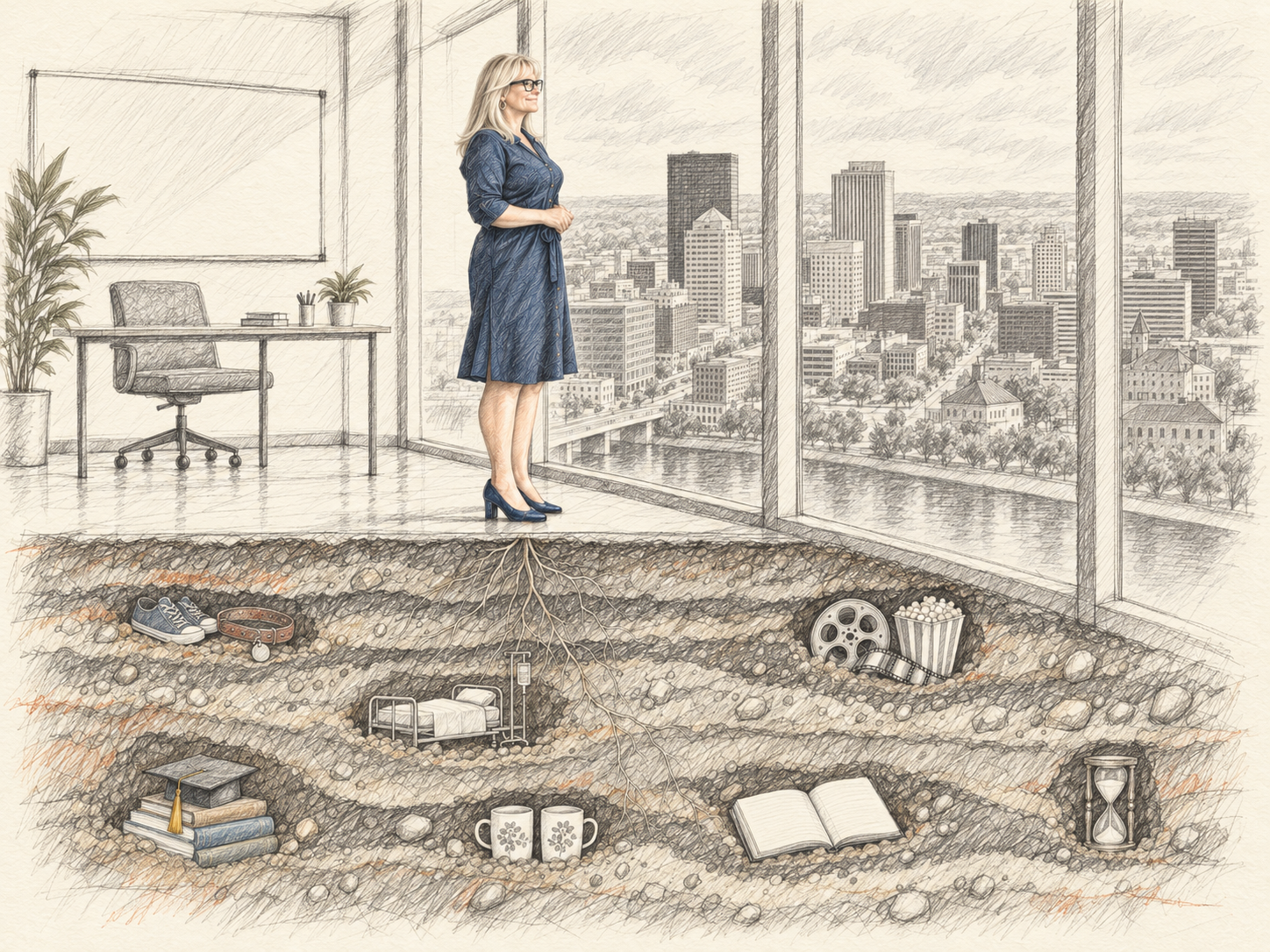
Starting over doesn’t mean starting at zero. A lifetime of learning, love, loss, and experience comes with us. AI-generated illustration created with ChatGPT, concept and art direction by Susan Marie / Scenescape Media.
This does not mean the new life replaces the old one or retroactively justifies its loss. A death is not secretly a gift. A diagnosis is not a life lesson wearing an inspirational T-shirt. A divorce is not the universe’s way of clearing space for something better. Growth may follow suffering, but that does not make the suffering a favor in disguise. It means the suffering did not get the final word.
That distinction matters because the crisis is not the plot twist.
The crisis is the event that broke the expected plot. The plot twist is what becomes possible afterward.
The unimpressive work of beginning again
At first, possibility rarely feels exciting. It looks like logistics.
You change your emergency contact and stare at the form for longer than you expected. You learn which bills are yours now. You rearrange the medicine on the bathroom counter. You cook for one instead of two, or take a different road home because the familiar one passes the hospital. You plan a Tuesday night that no longer includes the person around which Tuesday used to revolve.
None of this arrives with a cool soundtrack. It does not feel like reinvention. It feels like paperwork with grief attached. In triplicate.
But each ordinary decision puts one small piece of your life back into your hands.
You choose where the chair goes. You make the appointment. You accept an invitation, take a class, walk around the block, or decline something you no longer have the strength to carry. You try one new routine and abandon another that does not work. You begin to learn the shape of the life that exists now rather than continually measuring it against the one that was supposed to be here.
The choices are often unimpressive from the outside. From the inside, they are evidence that the crisis no longer gets every vote.
That is where chosen and forced change begin to meet.
When we choose a change, we exercise agency at the beginning. We decide to leave, begin, learn, build, or try. When change is forced upon us, agency returns later and more quietly. We cannot choose the event, but eventually we begin choosing within the life it left behind.
This does not mean that we can control every outcome if only we adopt the right attitude and buy a fancy new planner. Circumstances remain real. Money, health, responsibility, opportunity, and other people’s choices all place limits around what comes next. But a limited choice is still a choice. One vote does not control the election, but it counts.
Over time, those decisions add up to something recognizable as a life.
Not a dramatic unveiling of a new and improved self. Not a triumphant “after” photograph in which every visible trace of the former life has been tastefully removed.
Just a life that fits the facts as they are now.
We do not stop missing what was lost. We do not have to pretend the original plans were foolish or that the earlier chapter was a mistake. A chapter can be good, meaningful, and complete without being permanent. Beginning again does not require us to disown what came before. It asks us to carry it differently.
What the plot twist changes
In fiction, a plot twist is not simply a terrible thing that happens to the protagonist. It changes what the character understands, what becomes possible, and what must happen next. It may send the character in the direction where they solve the mystery, catch the killer, find the treasure, locates their courage, or fall in love.
Real life is less tidy and considerably worse at pacing. The mystery may remain stubbornly unsolved. There may be no treasure. Nobody hands us the revelation so we can enjoy the denouement.
The metaphor still earns its keep because it makes one thing clear: an unexpected turn does not mean the story has failed. It means the original outline can no longer contain it.
The protagonist enters the next act carrying everything that happened in the earlier ones. Experience becomes context, competence, motivation, conflict, and, on good days, comic relief. The previous chapters are not erased simply because the story has changed direction.
There is no requirement that we rush toward this next act. Reinvention is already in danger of becoming another cultural obligation: optimize the setback, extract the lesson, emerge visibly improved, preferably thirty pounds lighter and equipped with a personal brand.
The plot twist creates possibility, but it does not set a deadline.
A person is allowed to grieve. To be angry. To rest. To spend some time doing nothing more inspiring than getting through Tuesday. The story continues whether or not we are ready, but continuing is not the same as hurrying.
Perhaps starting over is simply the wrong name for what happens next. We are not returning to the first page, stripped of everything we have learned and loved. We are turning a page we did not expect to reach. Sometimes we choose the turn. Sometimes life turns it for us, roughly, without asking.
Either way, we arrive carrying the whole story.
The crisis may have torn up the outline. The plot twist is that it does not write the next chapter.